Showing posts with label Order of the day. Show all posts

Monday, 21 September 2009

"To the foreigners" - A notice from the local police

.
.
The following appeared outside my door earlier this evening:

To the foreigners:

October 1st, 2009 is the 60th anniversary of founding the People's Republic of China, Celebrations and Eve Gala Evenings will be held accordingly. The close down and cordon off area will include the area that you live in curtain period. For the smooth going of your daily life, we take pleasure in announcing the following issues:
  1. Please reduce your going out as possibly as you can. While having to go out, please definitely take your passport and the temporary accommodation register form.
  2. You had better refuse the visitors who possibly cannot arrive at your abode.
  3. Please save certain of living necessity, then the peripheral store won't can provide convenience.
  4. Please obey the policeman's direction and control. Your co-operations are most appreciated.
  5. Please pay attention to the government's announcement about traffic control, and work well your route of travel arrangement in advance.
Dong Cheng District Public Security Bureau wish you having a happy life in our magistracy!

Dong Cheng District Public Security Bureau
September 4, 2009

Monday, 10 August 2009

China, cheesier than ever...

.

As an ex-cheesemaker, I was excited to hear about Le Fromager du Pekin, which, according to a Daily Telegraph article, is Beijing's first French-style Chinese cheese manufacturer.

.

Say Cheese...


Liu Yang learned his craft in France while studying management. After befriending a shepherd who taught him how to make goat's cheese in Corsica, he enrolled at the local agricultural school. "All the people studying with me came from cheese-making families and they were all French. I was the only foreigner and I couldn't make cheese," he is quoted as saying.


On his return to China, he set up shop, importing equipment from France and asking a local engineer to make him a cheese-making vat. Mr Liu makes blue cheeses and a Camembert with the slightly disappointing name, "Beijing Grey."


Having thought hard about Chinese cheese names suitable for The Peking Order, I came up with a controversial mild Dutch cheese made on the Yangtze River, the “Three Gorges Edam.”


Another suggestion for Mr Liu is a tribute to China’s first emperor and his mausoleum in Xi’an, the “TerRICOTTA Warrior.”

Wednesday, 5 August 2009

Over 1,000 websites feature “problem maps”

.
According to an article in today’s Beijing News, as part of a recent drive to correct “geographical information,” authorities in Beijing have found that over 1,000 websites contain maps with “bits left out” or “incorrect bits.”

Approximately 10,000 websites were reviewed, including large Chinese sites like Sina and Netease. Most of the 1,000 problem websites were identified because of irregularities relating to Chinese territory.

The article goes only some way to clarify the vague terms used, saying that in some cases, Chinese territory, including the disputed Diaoyu Islands and Taiwan, had been marked as being outside of China. In other cases, “state secrets” had been divulged.

Various departments, including the Beijing planning authority and the Ministry of Commerce, will form a joint taskforce to audit the sites. According to a government official quoted by the newspaper, websites will be dealt with according to nature of the irregularities., with the most serious violators being shut down.

Sunday, 26 July 2009

Nanluo nail house?

dk
The Beijing News followed up today with further reporting on the construction at Nanluoguxiang. While the main article claims that evictions are going smoothly, a brief side story talks about a family who are unlucky enough to live in a gongfang (公房)- a type of public property - within the demolition area. Below is a direct translation:

To the north of Di'anmen Dongdajie and to the east of Nanluoguxiang, blue construction barriers obscure a single gateway. Most of the buildings behind this have already been demolished. However, further into the courtyard, standing among rubble, a single home remains. Both telephone and TV have been disconnected.

After letting us in to her home, Mrs Fu explains why she has not moved out: "No agreement has been reached over compensation."

Along with her family of three, Mrs Fu has lived in this home - a 30-square-meter gongfang - for the last 20 years.

"We have had several discussions with the demolition company, who, after initially promising compensation, went back on their word. We have still not signed any contract." While Mrs Fu refused to reveal the exact amount that she is asking for, she told us that she is hoping for enough money to be able to buy a three-bedroom property within Beijing's third ring road.

A potential nail house (钉子户), right on my doorstep?

Saturday, 25 July 2009

“Knock-down” prices in Nanluoguxiang

.
Authorities deny that astronomic amounts of compensation are being given to those currently being evicted from Nanluoguxiang, according to an article in today’s Beijing News.


Behind the blue construction barriers that obscure much of the south end of Nanluoguxiang – a traditional Chinese alley filled with small shops, bars and hostels – much of the picturesque architecture has already been flattened. Shops and bars within the demolition area are currently offering discounts and promotions, with a sign seen yesterday offering drinkers “one last night of craziness.”

According to authorities, buildings are being pulled down to make way for the construction of a new subway station. Due to be completed in 2012, the development is part of the planned extension of Line 8, which will connect the National Art Museum in the south and Huoying (Line 13) in the north.

The Beijing News article is a response to earlier reports and rumours that suggest that occupants of buildings earmarked for demolition were to receive as much as 300,000 yuan per square meter in compensation (average property prices in Dongcheng District are around 10,000 yuan per square meter).

“Compensation above 100,000 yuan per square meter?” said a spokesperson for the planning department yesterday, “That’s impossible.” According to the official, demolition and evictions were progressing smoothly, and average compensation would be more like 50,000 yuan per square meter. Payment of compensation would shared by the Dongcheng District Government and the subway construction company.

However, despite official optimism, some businesses within the demolition area are showing no signs of closing, and media reports have indicated that evictions are not going to plan. According to People’s Daily Online, 20 occupants are yet to reach agreements over compensation. The report goes on to claim that the authorities, having entered into negotiations, may begin to forcibly evict occupants that are demanding exorbitant levels of compensation.

------------------------------------

On a happier note, The Peking Order would also like to wish Ned’s – an Australian bar located half way up Nanluoguxiang – a very happy 1st birthday! Close friends of this blog, the owners made the right decision when selecting the venue for Ned’s. If it was not for the fact that a deal to rent premises at the south end of the street fell through at the last minute, tonight’s anniversary party could well have been the final piss up before the bulldozers roll in!

Wednesday, 22 July 2009

Order of the Day: Tortoise knocks girl senseless

.
A "shell-shocked" girl has lost her memory after being hit on the head by a pregnant tortoise, reads an article in today’s Sun newspaper.

Unsuspecting Chengcheng was struck by the 3lb creature as she walked with her aunt in Chongqing, central China.

The 12-year-old girl [pictured right], was knocked unconscious and left with a deep gash wound across her head.


The tortoise [pictured above] survived the initial fall but after laying several eggs, died from its injuries.

"Given the force of the blow," said a police spokesman, "this tortoise, which weighed 3lbs, must have been thrown from a reasonable height and we have questioned 16 flat owners, all of whom have denied responsibility."

The injured girl's father, Liu Xingbing, said: "I am furious at this irresponsible behaviour."

Monday, 13 July 2009

A perfect blog post

.

Note that a nail has not been used where the diagonal strut meets the straining post, made possible by chiseling a neat(ish) hole, inside which fits a strut that has been cut to the correct angle so it lies flush with the post. Nails are a totally uncool way of constructing strainer assemblies like the one in the picture, they look ugly and cause the wood to split, which brings on rot.

I have not updated my blog for such a long time, partly because I have been in England, and partly because The Peking Order, along with all other Blogspot pages, Facebook and Twitter, is now unavailable in China. I am using a proxy server to write this; If you are in China, you are using a proxy to read this.

Now that I work for a trendy PR firm, I feel the need to upgrade my "new media" credentials. Check The Peking Order regularly, which I will update when possible, and look out for me on Twitter, which I am told is good. 

Sunday, 22 March 2009

Beij 3: Perfume girl kicks up a stink

.
Perfume Girl (香水女生) will return to school next week, reported The Beijing News on Friday. This is the mundane conclusion of a story that involves Wang Tingting (王亭亭), a fourth-year German language student at Beijing Foreign Language Studies University (BFSU), and her criticism of China’s compulsory foreign language education.

"Buff Tingting"

On March 16th, Wang wrote that because of comments on her blog, which included criticism of China’s Ministry of Education (MOE), she had been forced by the university to quit her studies. While some have backed her criticism of the MOE and BFSU, many netizens have accused the girl of being interested purely in self-promotion - they smelled a rat, rather than perfume, and questioned why she would post so many photographs of herself on a blog entry about being kicked out of school.


The Peking Order, which takes an interest in both Chinese education and girls that look good in pink velour tracksuits, translated some of her blog to see if there is anything to her claims:

Zhao Benshan for Education Minister

In her first critical blog entry, Wang likened China’s Minister of Education to an “executioner with a stranglehold on human talent.” “Exam-based education, compulsory foreign language classes from elementary school, an inflexible college entrance exam system, and universities that do not allow transfer between departments,” she wrote, “are suppressing and destroying human talent.”

Wang went on to recommend Zhao Benshan (赵本山), a well-known Dongbei comedian, for the position of Education Minister. Unlike Zhao, who successfully popularised Dongbei dialect within 10 years, “the Ministry of Education is unable even to fully popularise Mandarin."

When Chinese people think of foreign languages, claimed Perfume Girl, the first thing people think of is not pleasure or fascination, it is “destroyed childhoods and the extreme study pressures of youth.”

Foreign languages depriving Chinese of the right to education

The next blog entry went on to complain that “foreign language study is depriving Chinese people of their right to education.” “Regardless of your interests or which direction you want to head in, whether it is history, Chinese, Chinese medicine, archaeology, foreign languages are a hellish gate that the you must pass through.” However talented someone might be at his or her own subject, she wrote, the talent will be choked out by an inadequate grasp of foreign languages.

Foreign languages holding Chinese people to ransom

In her final diatribe before claiming to be kicked out of university, Perfume Girl called on people to “abolish compulsory foreign language education.” This article describes how “foreign languages holding the lives of Chinese people to ransom,” how languages are emphasised at every stage of a young person’s development: from aged three, where “tiny souls are bewildered by foreign languages;” through to graduation where “spoken English, business English and all sorts of foreign language certification, are enough to stress anyone out.”

-----------------------------------------------------------------------------

Apart from a few nicely-written slogans and the amusing Zhao Benshan analogy, there is nothing special about these comments. Miss Wang’s blog entries are hardly objective criticisms, and like a lot of the Chinese articles I read, they lack logical reasoning and are not backed up with evidence. Her arguments could be summarised into two points: foreign language requirements might hold back those who would otherwise succeed in other subjects; and that many resent studying foreign languages in China.

Both might be acceptable evils if the current system was improving the level of English in China. However, if China's schools are making many unhappy and are stifling talent, then considering my experience of the English levels despite compulsory study, The Peking Order thinks that these complaints are legitimate and that it maybe about time for a drastic rethink of China's education system.

-----------------------------------------------------------------------------
According to a recent entry on Perfume Girl's blog, hackers have deleted all offending entries. Luckily, others have posted full copies of what she wrote:

Zhao Benshan for Education Minister (Chinese)
Foreign languages depriving Chinese of right to education (Chinese)
Foreign languages holding Chinese people to ransom (Chinese)

Monday, 23 February 2009

More words on the street…

.
…or should that be more words used badly on the Chinese streets?

The amount of English words that should be “mastered” as preparation for China’s college entrance English exam will “continue to increase steadily,” reads an
article in yesterday's Beijing News.

The story quotes the recently released “2009 Examination Handbook” - essential reading for almost every 17-18 year-old Chinese high-school student, who sits the annual exam as a prerequisite for all undergraduate study in China. When the measure comes into effect, the students should prepare an extra 101 English words, raising the number of officially recommended words to 3500.

The Peking Order was unable to obtain a copy of the 2009 document. However, unofficial lists are likely to become available online as students upload transcribed copies of the vocab. To get an idea of the type of words on the 2009 list, I looked at the
2008 words, which can be viewed on various web forums. “Arbitrary,” “vacuum,” “undergo,” and “expenditure,” are a few of the harder words that I found.

Many who have used English to speak to certain Chinese people will doubt the ability of this measure to improve English literacy. I believe China’s education system, criticized for its emphasis on bleary-eyed rote learning, is partly to blame for the relatively poor English in China. Although following the examiner’s recent advice may aid comprehension of written English, I believe it will encourage memorising a greater number of more difficult words. This will come at the expense of time spent studying basic words, and, therefore, will do nothing to improve standards of written and spoken English communication in China.

In my opinion, it would be best to reduce the words on this list, and encourage studying the flexible usage of verbs like “to go” and “to be.” Due to differences between English and Chinese, namely a lack of verb conjugation in the latter, native Chinese speakers are not used to changing verb forms according the tense, subject, etc. Only after these basic words - and their conjugations - are correctly understood, should a student move on to more difficult words.

Considering that I have trouble using some of the words on the recommended list, for many Chinese high-school students under the current education system, there is not a hope in hell of being able to reproduce such difficult words accurately. An increase in recommended vocabulary is not, therefore, good news for China’s English. On the contrary, I suspect it will result in more words being used incorrectly, increased frustrations of foreign English teachers, and more misunderstandings between Chinese students of English and anyone who has genuinely mastered the English language.

Tuesday, 30 December 2008

Employment reaching critical levels...

.
Today's post has nothing to do with my recent inability to earn money. The headline is in fact a reference to one of my side projects: writing reviews about Beijing's top restaurants. For many of those that know me as someone who needs to be told when something was salty or had too much garlic, news about this tasty endeavour may be somewhat difficult to swallow.
.
The reviews I have been writing over the last few months are for the website, BestFoodinChina. Although the work is unpaid, it is good experience and the lavish free meals that I eat once a week make a nice change from my financial-crisis staple: eight yuan (80p) fried rice.
.
Although the current website leaves much to be desired, one thing BFIC can be credited for is that it has a regular column in China's major English-language newspaper, the China Daily. Here are a couple of my reviews that were posted on their website:
.
.
Honzen – more than raw talent...

The restaurants of large hotels can be peculiar environments, sometimes with disappointing and over-priced food. Yet, discreetly tucked away from the over-bearing marble lobby of the Kempinski Hotel, the Japanese restaurant Honzen has little of the unmistakable and unsettling transient atmosphere that permeates many hotel-based eateries; there is also none of the complacency that you might find in a chef who knows that...
Read more
.
LAN Club - a Starke contrast
.
Danny Wang was not the first to feel it his “duty” to introduce Chinese food to the West. However, as owner of this restaurant, he was perhaps among the first to successfully locate the less-than-original “traditional meets fashionable, Chinese meets foreign” dining experience in such original surroundings.

Welcome to LAN Club - the 6000 square metres of curious opulence that stretches between... Read more

Saturday, 20 December 2008

Darling buds of mei

.
On Friday, a leading Beijing newspaper, The Beijing News, named actress Zhang Ziyi as the most beautiful person in China, 2008.

Public appeals by the 29 year old to raise money for the Sichuan Earthquake relief effort might have had something to do with her ability to garner the public vote, especially considering that many Chinese people have never rated Zhang Ziyi very highly.

Zhang’s beauty is a topic of conversation often endured by foreigners in China. Many Chinese people seem to find it incredible that the actress has been able to win such Western acclaim. “According to Chinese standards of beauty”, I am often told, “Zhang Ziyi is not that beautiful”. This tedious topic ranks just below enthusiastic explanations that “Chinese is the hardest language in the world” and “Sichuanese food is very spicy”.

Last year's winner was the actor Huang Xiaoming. Perhaps the fact that Huang is not among the 50 names on this year's list will bring strange comfort to his embittered former English teacher.

Saturday, 29 November 2008

Does this make me any Lhas-a man?

.
On Thursday, The People's Daily posted the following article on their English-language website:
Improvements made to Tibetan civilian residential housing
In recent years, central government has invested a total of 120 million yuan, and has finished renovating 67 dilapidated courtyards in the old part of Lhasa. The total area covers 140 thousand square-meters, and reconstruction has greatly improved the housing conditions of 2,668 households. Read the rest here.
Great news! And as one of the people behind this, I hope it's all true.
.
Now a week into my new job - translating, editing, and double-checking People's Daily and CCTV articles to be published on their respective websites - this is the first piece that I have dealt with that could be construed as being propaganda.
.
For this article, I was responsible for the third stage - double-checking to make sure that there are no inconsistencies with the original Chinese. One thing I questioned was a word in the first sentence: “国家 guojia” - which had originally been translated as "government". Literally, the word means "country" but translating the word in this way could be a tacit admission that Tibet more than just an autonomous region. However, I thought that by simply leaving it as "government", it could still be confused as being a regional government investment, so I suggested "national government". After some discussion, the phrase "central government" was decided upon.

Wednesday, 19 November 2008

Daddy Long Legs!

.
Sheng le HIGH-zi!

The world's tallest man has become the world's tallest dad. Bao Xishun, who stands at 7ft 9ins tall, became a father last month. The first pictures of the proud dad cradling baby Tianyou - a normal 22 inches in length - were released today by The Sun.

A moving story indeed. But not as moving, perhaps, as his famous dolphin rescue back in 2006. Lucky for the aquarium, whose vets have only arms of average length, Mr Bao was on hand to remove some plastic that was stuck deep down in this poor creature's stomach.
.

Saturday, 15 November 2008

The China Petroleum Equipment and Technology Exhibition – a crude joke!

.
Experts or ex-pats?

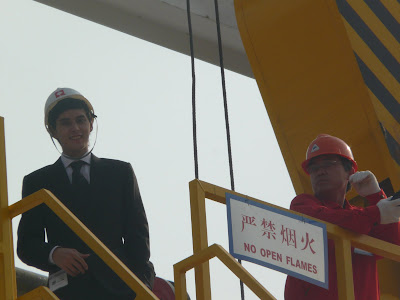
The 2008 China International Petroleum Equipment and Technology Exhibition concluded last Friday in the eastern city of Dongying. 3000 guests from over 40 countries attended and everything appeared to run smoothly. Yet the majority of the foreign delegates were hired just to make the event look "international". Among the 200 fake delegates was Jez Webb, The Peking Order’s energy correspondent.

Most guests had responded to an ad on theBeijinger.com with the curious title: “Free trip to Shandong, 200 foreign visitors invited (Be paid)”. We would, depending on our age, receive between 600 and 700 RMB (£60-70) for two days “work” – two 6 hour bus journeys to and from the city, full board in a luxury hotel and a couple of hours walking round an exhibition, pretending that we were involved in the petroleum industry.

For many, the 6am wake-up call had followed a heavy night in Dongying; free beer was supplied with our meal and 0546, the city’s main nightclub, had put on quite a show for its anticipated guests. So it was with non-renewed energy that most of us trudged around the exhibition hall accepting promotional material from enthusiastic sales representatives - all of whom blissfully unaware that none of us “delegates” knew our casing heads from our choke valves.

名骗:Hundreds of identical name cards were given to fake delegates; dozens of "Claytons" attended the event.

The whole city had been lied to. Roads were closed off and we were given police escort to ensure safe passage to and from the hotel. Crowds were addressed by leading provincial government figures as well as foreign leaders. The Dongying Daily - a paper so excited that it printed the front cover in full colour for the few days we were in town - also failed to smell a rat and reported on the success of the "ground-breaking event".

By the time the stall holders began scratching their heads over the fact that they had collected several identical business cards we had already begun the arduous bus ride back to Beijing.

------------------------------------------


Rather than arrange for real industry people to be flown in from around the world, the event organisers thought that 200 members of Beijing’s otherwise idle foreign population – a mixture of students and casual workers – would be enough to lend the exhibition the international quality it needed.

Can you tell a real delegate from a fake delegate? The bloke in the red helmet couldn’t.

How could the organisers get away with this? After all, a quick chat with any of the overseas “delegates” would have quickly revealed that something was amiss. However, the language and cultural barrier, especially without the help of any investigative reporting of the event, makes for a gullible Dongying. The exhibition was an example of Chinese people using foreign faces to trick other, more ignorant Chinese people. And unfortunately, as long as Chinese people are bad at English and in awe of the foreign face, this type of façade will continue to be put up throughout China.

Monday, 10 November 2008

Panda to The Peking Order - Come on my Sun!

..
The Peking Order was delighted to see that the following had been published today in British tabloid, The Sun. We think that by giving such treatment to Chinese stories, the newspaper has the right idea. However, one must wonder from which witty blog they took inspiration...
Hey, panda eyezzzzzzz
IT’S hard work being a panda cub – and these exhausted specimens can bearly keep their eyes open.
The cuddly characters curled up for fur-ty winks before feeding time at a busy breeding research centre.
Bosses at the base in Chengdu, South West China, hope to boost numbers of the endangered beast via artificial breeding techniques.
But this dozy lot were more interested in their bamboo-ty sleep.
After all, they wouldn’t want dark rings round their eyes.
If readers hadn't guessed, the photograph referred to by the article is of a group of sleeping panda cubs. Unfortunately the picture was not to be easily removed from the paper's website. It seems that The Sun is far more generous with its word play than they are their intellectual property.

Thursday, 6 November 2008

周鱼 and his Strife Aquatic

.
Last night I cleaned out the fish tank that was lying unused in my back garden and bought myself four fish. Before the water had settled, I was already beginning to regret my decision.

Not the first tank to appear in Tiananmen with disastrous consequences, my ugly aquarium claimed its first casualty last night. Meanwhile, its three remaining occupants continue to irritate their irresponsible owner. So before the others all end up down the bog, I thought I should put them on the blog.

Tuesday, 4 November 2008

Visitor numbers Peking at 1000?

.
The Peking Order had not only Halloween to celebrate this past weekend. As this blog removed its “Freaking Order” costume on Monday, the number of visitors passed the 1000 mark. Of course, most of them are probably the blogs self-indulgent author, but I think this occasion warrants a glance back at some of the less successful hits, and a look forward to the blog’s future.

The Peking Order learned recently that its “dogged and determined” use of wordplay is sailing over the head of at least one person. One young lady, let’s call her “Miss Pun”, failed to smell something fishy when she saw the word “opportunarists”. This was no spelling mistake. Unlike Yan Xishan, the same person also failed to notice that the English title of this blog has two readings – take another look if this comes as news to you. The general rule is: If something looks odd, it is probably an example of my “deft yet distracting” use of puns.
.
I would forgive most of the readers for not getting The Peking Order’s Chinese name,京制 – I’m not even 100% sure myself that it works. If anyone has anything to say about this – please leave a comment. Perhaps Mr Yan would like to earn some extra “points” here?

This blog might one day prove that “political power can grow from the barrel of a pun”. Hopefully along with some collaborators, The Peking Order will give China the “tabloid” treatment – short, sharp and silly news articles placed daily alongside regular blog entries. If censorship can be avoided by posting only tongue-in-cheek re-writes of existing Chinese newspaper articles, who knows, The Peking Order might one day grow into a reliable expat news source in China.

Monday, 3 November 2008

Lower the Tone – Three Thirds make a...

.
My “tone fetish” has reached all new lows. Anyone who does not share my perversion for the finer points of Mandarin should look away now.

I posted the following on theBeijinger:
.
How do you pronounce three third tones in a row? For example, for the name of Lu Xun's antihero, Kǒng Yǐjǐ - 孔乙己?

Mandarin learners know that when two third tones are together, the first becomes a second tone, and that if a third tone precedes a second tone, the tone is cut in half, only the first half being pronounced. Considering these two axioms here are three potential solutions:
  1. Kong(half third) Yi(second)ji(third) - this seems like quite a mouthful.
  2. Kong(second)Yi(third)ji(third) - in which case one rule is not being observed.
  3. Two second tones followed by a whole third.
I even emailed John at Sinosplice with this query. As one of the voices behind Chinesepod, I consider him an expert. Neither him, nor the 57 readers of my forum post, replied. As well as proving that I have too much time on my hands, this lack of response demonstrates that mine is either a very stupid or a very difficult question. Either I have uncovered a contradiction inherent within the Chinese language, or, more likely: I have missed something.

If anyone, especially Chinese readers (write in Chinese or English) could shed some light on the subject, The Peking Order would be grateful for a comment.

Thursday, 30 October 2008

Flats that take the pistol

.
Tudor townhouses, Spanish villas and Bordeaux cottages are just some of the foreign styles aped by modern Chinese housing projects. However, the concept of importing "a bit of the West" is taken to new levels by a half-page advert in The Beijing News on Wednesday. Top Down - a brand new apartment complex coming to Beijing - seems to be emulating a very different aspect of foreign culture: Britain's gun crime and hoodie "plague".

"I'm not doing it for the money", read the large characters at the top. This, I think, is one of Top Down's guiding principles. However, I can't believe claims that this is a company owned by its workers, less still am I willing to believe that this is a not a profit-led venture. After all, would you trust the man in the advert?

Wednesday, 29 October 2008

Xiangshambles - Red leaves? Hong yeah right!

.
“All the leaves are brown, and the sky is grey”. Just the second point was confirmed by my visit to Xiangshan Park earlier this week.

According to an article in today’s Beijing Times, strong wind over the last few days has caused many of the leaves to fall prematurely in Xiangshan Park – Beijing’s number one spot to check out the reddening autumn leaves. Perhaps this explains why most of foliage that I saw was still green. “Once leaves turn red, they can’t stand up to strong wind” said a member of staff quoted in the paper; he goes on to remind travellers to get to Xiangshan as early as possible this year.

The Peking Order wouldn’t recommend that anyone hurries over to Xiangshan. An editorial published on Monday by the same newspaper raises similar concerns and describes the strain placed on these famous “red leaf spots” – on Saturday alone 80,000 people descended on Xiangshan Park.

The editorial also points out that this coming weekend is likely to see a peak in the number of tourists. Could it get any busier than it was on Monday? That day I saw more tour group red hats than I did red leaves. It was a ghastly experience, one that I could endure for just half an hour.

My advice couldn’t be simpler: leaf this one out!